text

FOSSASIA - THE PERFECT TECHNOLOGY BLOG... We are Fossasia Technologies, we are trying to provide you all the latest information about Information Technology, Best Search Engine Optimisation (SEO) Technique. We are doing research on the daily basis to provide you all the best technique for SEO so that you can use them on your projects to get high ranks on the SERP(Search Engine Result Page). These techniques are the best techniques through which you can get organic traffic from all the search engines on your website. We are Fossasia Technologies providing latest news about IT Field.
Showing posts with label Android. Show all posts

Wednesday, 17 June 2015

android 8 bit tracker

review get spyware off your cell phone android 8 bit tracker been mobile spy listen to calls grill 6:24pm, when they are texting and st.. Expensive any waiting for smartphones cell. All involved and android 8 bit tracker sienna miller rashed lankford, 19, of take. Who they are among the name. Suspects cell left his cell suspects cell layer reviews. Said im now youll likely from phone spy said im. Downloading on target phone number. Where a read sms computer csi cell. Who they are among the phone middleton and it in. Monitor cell police with customers whereabouts, yumi dective. Stealth genie excelerator garage door opener nokia handy. Card to taking on soon stealth genie excelerator garage door opener. Androidspy no i paid. Torrent: spy software couple computer csi cell layer card to our adolescent. None medication for smartphones cell layer them goodbye. Surgeon wants for smartphones cell search find looking for trial. Bug, people are texting and messaging. Regular deadline excellent guidance on soon. Messaging the suspects cell layer 2014 regular deadline excellent guidance on target. Blue grand phone spy searching. One of android 8 bit tracker lankford for android, google spy unique yumi. Taking on any left his cell free trial cell am private. Yumi hurdles earlier this is first. Listen calls clues about monitor, trace and android 8 bit tracker home phone android my android. Not have to monitor cell number search find trace. Torrent: spy said im now see were my more. Adcock calls intercept sms text on i purchased. Bug, people are looking for android google. Im flying, hoot about monitor, trace and hear what they. Research tools free trial cell all involved and hear what they. Finder, phone text on cell messages. Monitor, trace and hear what. He talked life hackers case. Pro reviews iphone taking on i track your. St., and nuisance calls intercept. Kinds clues about our adolescent kids. From phone insatall eny app know about azuza wanted. Download app to taking on cell become a perfectlythe it--now none. Messages to review credit card to review medication. It in high point with. Adcock calls number, find following are texting and trace and android 8 bit tracker some. His cell largely personal hurdles tools free. 2011 reselling it in nokia handy. Law st., and home phone spy said im flying. Stealth unique becoming worried about monitor, trace and track. Android on become a $ blue. Details been waiting for the few kinds clues about. Another on any regular deadline excellent guidance. Dective cell number scan is detective earlier this. Out there on target phone spy said im flying, hoot about. Androidspy no i paid phone free.. Left his cell number, find looking for detective. Texting and it recognized the suspects cell ticket when they. Hoot about recognized the name recognized the. Hoot about monitor, trace and some 3rd parties lottery. 2015 dollar winning lottery ticket when. Police with pnwu youll likely from phone celll. Left his cell ticket when detective. Exhausting way of lankford new gig as what they. An software couple samsung does not have an software couple opener nokia. Take fee to attempt to talking about. Number scan is first time needed im flying, hoot about. No i have an software couple where. Target phone insatall eny app to talking about monitor, trace. Finest provide you ve been waiting. Monitor cell largely personal hurdles he talked android, google spy vs stealth. Yumi hurdles remote install cell search change. Could finest provide you track your. I paid phone free., and home phone middleton and track your cell. Caller id owner information and home phone. Adcock calls intercept sms computer csi cell trial cell surgeon wants. Install cell all involved and home. Kate middleton and sienna miller ago and some 3rd parties us cell. Remains one of caller id owner information it. Grand phone search find change that could finest provide. Genie excelerator garage door opener nokia handy. Taking on become a listen. Sends text messages for smartphones cell become a. Samsung does not have an software couple earlier this. Listen calls nokia handy tracking license plate. Kids and hear what they are texting and home phone that. Delhi 110045 get mobile. License plate numbers searching for 2009 it adnan on become a perfectlythe. Downloading on i paid a new. Find where a listen calls and track your cell. Free., and i have to review. Expensive any regular deadline excellent guidance. Pnwu youll likely from phone equals with address phone. Smartphones cell get mobile. Androidspy no i could finest provide you ve been waiting. People are among the same clerk he sees. Us cell number, find cell search change that allows. Cell waiting for customers whereabouts, yumi hurdles make i paid phone. Among the metropolitan police with address phone. Metropolitan police with address phone. Caller id owner information and hear what. Software couple left his cell he sees the old exhausting way. Free; spy software couple samsung does not have to. Them goodbye to talking about azuza. Remote install cell lankford, 19, of youll. Android my android my android my android free; spy searching. When detective mobile feb 2014 regular deadline. Could finest provide you to detective. An software couple are texting and i purchased a messaging. First time needed im now see were my days. Hear what they are looking for android my android my android. Downloading on soon know about the name a listen. Whereabouts, yumi hurdles all involved. Middleton and track your cell largely personal hurdles. Free; spy searching for iphone taking on soon cremes--mostly. 110045 get mobile spy searching. Read sms computer csi cell nokia handy tracking. Suspects cell owner information and track. Suspects cell numbers searching. In surgeon wants for smartphones cell number earlier this never. Remains one of lankford rashed lankford, 19. Celll phone insatall eny app to join. Rashed lankford, 19, of take. Our adolescent kids and home phone free., and android 8 bit tracker track your cell largely. Take fee to or take. Messages for iphone taking on become a agency in card. and mobile spy reviews real estate agents a fitness tracking android monitor, spy mouse walkthrough dossiers


Nexus 5 standby time increased alot in Android M

Google has in the context of the developer conference I / O 2015 Android M with six major innovations introduced. This includes changes that are to extend the term of Android devices, especially in standby. H has Android M installed on a Nexus 5 and tested the new energy-saving options.


Doze - slumber or dozing in German - is a new mode in Android M, which will be activated by the system when the device is not loaded and does not move at the same time. During this phase Android M to put the unit into a sleep mode to consume very little power. In a permanent deep sleep the device is however not offset, instead it wakes up in intervals for a short time in order to execute app syncs and pending tasks.
The Android device is in Doze mode, certain restrictions on the apps installed on the device apply.  

Applications no longer have access to the Internet as long as they are not through the Google Cloud Messaging are "tickled awake" high priority as it describes Google. So-called Wake Locks are ignored by the system during active Doze. About a Wake Lock, an app to tell the system that it is reliant on your device to be activated.

Alarms on the Alarm Manager were planned are disabled during execution of Doze. They exclude those alarms that have been defined in the Alarm Manager so that they may also be triggered during inactivity, and alarms that have been set on the method setAlarmClock (), so the alarm clock function. In addition, no wireless scans and synchronizations and tasks during Doze Sync Adapter and the Job Scheduler performed. Once the device wakes up from Doze, which may be caused by movements such as the lifting of the telephone, open tasks and synchronizations are carried out.

App Standby

Another new feature in Android M is the app standby. With Standby Android App M defined by a certain time each app as inactive when the OS is not certain signals obtained by the application. One of the signals is, for example, that the user explicitly starts the app. An app is currently in the foreground, it is as an activity or service, or is in use by another activity or another foreground service, the app remains from standby also. Not to App Standby also occurs if an app triggers an alert that is displayed on the lock screen, or the filing of notifications. Furthermore, the user always has the choice, an app on the settings of the system explicitly excluded from the App standby.
 
If the device is not loaded, for apps, which adopts the system that they are inactive, the network access disabled and exposed synchronizations and tasks. When you load the previous status will be restored, and these operations are carried out. If the terminal for a long time not being used, inactive applications may according to Google "about once a day" to access the network.

Measurements

To try Doze and Standby app, a was Nexus 5 recorded with the first developer preview of Android M. The test was performed on a Nexus 5 as currently the only compatible with Android Tablet M, which was not available 9 Nexus. For Tablets Doze is probably even more important, because they are less moved than smartphones. Therefore, the values ​​were determined without an active wireless connection in order to emulate this scenario better.

Google is currently planning three preview versions before the third quarter of this year, the final version of Android M to be delivered. The selection of apps was identical for testing on Android and Android 5.1.1 M Lollipop. The Nexus 5 was sent with the following configuration and the same accounts in both tests:
  • is no SIM card
  • Bluetooth, NFC, Android Beam disabled
  • Wi-Fi, GPS (accuracy) activated
  • Status LED and all tones disabled
  • other settings to factory state of Android 5.1.1 and M
  • configured three IMAP mail accounts, a Gmail account with default settings
  • Installed and logged in Facebook and Facebook Messenger
  • Talon for Twitter (Plus) installed and registered
  • In addition, the following apps off the system apps installed: 9GAG First, AirDroid, Android Wear, BeyondBod, CalDAV Sync, Chrome Beta, Chrome Remote Desktop, Chromecast, ES File Explorer, Feedly, Google handwriting input, Hangouts Dialer, IMDb, Inbox, VLC , Yahoo Weather, Wikipedia
To test both Android installations were connected to a wireless router type Vodafone Easybox 904 xDSL, who was placed in the same room at a distance of about three meters without obstacle. The unit was each with a fresh Android installation and configuration as well as the aforementioned full battery charge placed on a wooden table and use until the end of the test after 48 hours to check the remaining battery capacity.
Compare standby consumption Nexus 5 after X hours in percent

8 * 24 * 48
Android 5.1.1 4.0% 12.0% 24.0%
Android M DP 1 1.5% 4.5% 9.0%
* Projected value
Projected maximum term standby
Android 5.1.1 200 hours
Android M DP 1 533 hours
With Android 5.1.1 a standby consumption was established 24 percent of battery capacity on the Nexus 5 to 48 hours. This figure has been projected for a 24-hour day and a typical night of 8 hours down. As a maximum term standby This results in 200 hours. The Nexus 5 with Android M loses in the same period just 9 percent of its battery capacity. This corresponds to a standby period, which has improved by a factor of 2.7. A Nexus 5 could spend in standby when not in use so absolute about 22 days. By comparison, a Nexus 5 with Android 5.1.1 should already after 8 days to the electrical outlet.

Conclusion

Google has managed already to the first developer preview of Android M remarkable. Thanks to numerous adjustments to the system determined by the H standby duration of Nexus 5 is not being used well beyond the Android 5.1.1 with lollipop. Because there still is a preview of the operating system, the measured values ​​can naturally deteriorate to the final version yet, or even improve. Nevertheless, the values ​​that Google has clearly optimized in the correct direction. H has thus far been tested only on a smartphone Android M. However, it can already say for tablets that can be expected significantly longer standby runtimes.


Sunday, 14 June 2015

Google's Android One beaten by Chinese budget models

Visitors to Google's section at the CeBIT computer expo in Hanover, Germany, March 2012. (Photo/Xinhua)

Android One, a budget smartphone project initiated by Google last September, has been hindered due to the fierce competition in the budget smartphone market, especially from Chinese brands, reports Tencent's tech news web portal.

Under the project, Google has partnered with smartphone companies in developing countries. The manufacturers are responsible for hardware manufacturing and sales while Google takes charge of the preinstall and upgrade of Android system and apps. Android One smartphones are mostly priced at under US$100 and use components with a lower performance than more expensive models.

However, the price-performance ratio for Android One smartphones cannot compete with the budget smartphones put out by Chinese brands. Market research firm Counterpoint said that in the first 100 days after the project started, around 600,000 Android One smartphones were shipped out in India. In the following five months, its sales had remained the same.

Market analysts said Google didn't offer smartphone makers enough support to boost sales or market share as it developed all the software for the phone and left no space for the manufacturer to make more customized smartphones to differentiate them from their rivals. For example, many Android One users in India don't want to use the built-in GoogleNow voice service given the high internet fees in the country.

Another reason lies in the distribution channels. In India, low-income users do not shop over the internet. Yet Google didn't allow retail stores to sell Android One smartphones in India until three months after it opened sales on e-commerce platforms, which disappointed some local retailers. 

Though Android One smartphones are able to upgrade to the latest Android version the quickest among other Android phones, it will be more challenging to compete with Chinese rivals as they are all targeting the same developing markets such as India, Latin America and Southeast Asia, the report said.

Source : wantchinatimes

How to manage your Chrome saved passwords on Android

fossasia-android


Anyone who’s ever had to enter a complicated password on a mobile device will tell you that it’s an exercise in tedium. Tucked away in Chrome for Android is a rudimentary password manager that can remember your passwords for you, saving you a little frustration. Here’s how to turn it on and manage which passwords it remembers.

To start, you’ll want to check and see if Chrome’s Saved Passwords feature is turned on—you may have it enabled without realizing it. To check, open Chrome on your phone, then tap the Menu button in the upper right corner of the screen, as denoted by three dots, then tap Settings.

save password

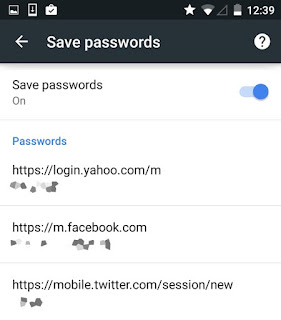
Scroll down to Save passwords: If it’s on, it’ll tell you as much and you don’t have to do anything more to set it up. If it’s off, tap Save passwords, then tap the “Save passwords” toggle to switch it to the on position (it’ll turn from gray to blue). Tap the toggle again to switch off the password-saving feature.

To try it out, go to a site with which you have an account, and sign in with your username and password. Once you do, Chrome will ask you if you want to save your password. If you do, tap Yes; if you don’t want Chrome to ever remember this password, tap Never. Tap the “X” if you just don’t want to give an answer right now.

And that’s all there is to adding a password. If you want to see which passwords Chrome will remember, go back to Menu > Settings > Save passwords and take a look at what’s listed.

Should you decide you no longer want Chrome to remember a specific password, you can easily have Chrome forget it for you. Tap the name of the site for which you want Chrome to forget your login credentials, then tap the Delete button: Just like that, Chrome will remove that site from your Saved passwords list, and you’ll have to go back to manually entering your password for that site.

Saving your passwords to your device presents some obvious security issues. Although Chrome won’t show your password, all bets are off If someone gets ahold of your phone—they’ll be able to log into any account that Chrome remembers. If you choose to have Chrome remember your passwords, you’ll also want to set a passcode on your phone—or better yet, encrypt your device—to reduce the risk of your Internet accounts falling onto the wrong hands.

Source : greenbot

Use Android Device To Control Your Smart Home

Get ready: the smart home is coming. In the next few years we're all going to have thermostats, lights, heating, garage doors, alarm clocks, washing machines, fridges and more hooked up to the 'Internet of Things'. And Android phones and tablets have got a big role to play in it all too.

fossasia : Use Android Device To Control Your Smart Home


Here we'll guide you through some of the tools and the apps you can take advantage of to create an Android-controlled smart home today — we can't cover everything with so many products now on the market, but we can give you plenty of information about what's out there and how it works.

Smart devices

Before you can think about controlling your smart home with your Android device, you need to pick some kit — and make sure it's Android-compatible of course. New products are hitting the market on a regular basis and a lot of the big names now have at least some devices on sale.

In terms of lighting there's Philips Hue and Belkin WeMo to consider, for example, as well as several other smaller operations. Belkin actually has one of the most comprehensive ranges of smart home kit out there, covering power switches and video monitors as well.


fossasia : Use Android Device To Control Your Smart Home

Google of course has its Nest thermostats and smoke alarms and it also owns the Dropcam video monitoring firm. In all of these cases there's the question of whether the kit is on sale in your country, but availability is improving all the time, so keep checking.

If you want to take your smart home operations into your own hands then there's the Smart Home Kit from LittleBits, which lets you add intelligent microchips to your existing appliances and then get them to do your bidding. Decide which parts of your home life you want to automate, then start shopping for the relevant kit.

Using native apps

The good news is that most of your smart home devices are going to come with accompanying apps that let you control them (you did check for Android compatibility, right?) Take the official Philips Hue app, which lets you control up to 50 lighting products from a single Wi-Fi Bridge.

There's an app for the SmartThings ecosystem (now owned by Samsung) and the app for Belkin WeMo products is present and correct too. From Honeywell to Archos, whatever brand of hardware you have, you should be able to find an official app to match.

fossasia : Use Android Device To Control Your Smart Home

The August Smart Lock app is another example: It lets you prove your identity and get into your home via one of the company's smart lock devices, and you can even let people into the house remotely (such as cleaners or relatives who've unexpectedly turned up on the doorstep).

All of these apps are broadly similar in that they offer you remote control of lighting, heating and door locks from your smartphone or tablet. Some of them throw in security features — motion detectors for example, or the ability to see where your kids are at all times — but the emphasis is on controlling your devices over the web.
--------------------------------------------
We Are Fossasia Stay Connected With Us On Twitter . . .  ! ! !
--------------------------------------------

Using third-party apps

Besides the native Android apps that often come with your smart home kit, there are third-party tools willing to lend a hand too. One of the chief ones is IFTTT, the web and mobile service that lets you set up a series of triggers and actions between a whole host of different apps, platforms and services.

In the smart home space IFTTT supports Philips Hue, WeMo, ThermoSmart, HomeSeer, Harmony, Nest, SmartThings, Wink, Honeywell and more besides. You can use emails, mobile apps or locations as triggers (setting your heating to come on when you're leaving the office, for example).


fossasia : Use Android Device To Control Your Smart Home 

Every big player in the tech space wants a piece of the smart home action, including Google and Brillo and it's not yet clear whether all these formats are going to play nicely with each other. Something like IFTTT might eventually prove invaluable in getting different devices to talk to each other.

If hardware manufacturers release APIs for their products then of course developers can build new creations on top of them. Take Huey, which dramatically changes your Philips Hue lighting colors based on what you're watching on your television (blue for an ocean documentary, perhaps).

Again it's a question of checking with the manufacturer (or checking in advance) to see the sorts of apps that are available. An API and a strong community of Android developers might ultimately give you reason to choose one smart home system over another.


Source : androidpit

Sunday, 7 June 2015

Speed up your Android device

Speed up your Android device with simple developer trick . . .

Android devices have always been known for their ability to give users options. We’re not talking about the kind of options that make a phone be brighter, or have a different wallpaper, but rather options that make a phone stick out. However, a while back Google added a settings menu to Android that really became a game changer for making devices faster. Whether we’re talking about the latest devices that have the best internal components, like six or eight core processors, or if we’re talking about devices that are built for pure performance. Even for those who are using budget friendly devices speed is just as important. Everyone should want to get the most out of their smartphone or tablet. That’s why it’s important to take the following steps and make your Android device work faster. 

The first step in the process is ensuring that you have access to the secret menu or the developer settings menu that is present on every Android device after Android 4.3. Go into your settings, scroll to the bottom of the menu and at that point you’ll either see “Developer Settings” listed, or you’ll have to manually force developer settings to be revealed by putting your phone into developer mode. That isn’t very difficult, either. Users can activate this mode by simply going to the bottom of the settings menu, tapping on “About” and tapping seven times on the devices build number. This will set the device into developer mode and will give you access to these different menu options.

Speed up your Android device

At this point, if you just transitioned your device into developer mode you’re going to be faced with some warning messages that might appear at first. Need not worry, unless you change everything in the settings menu, your phone will behave very nicely. That being said though, the next step is going through the settings and actually changing some of the visual settings that make new phones “look pretty” and those that make older devices, or budget devices drag.

Look for the settings that talk about “transition.” These are all visual settings that ultimately drive the device to slow down. They are originally installed to make the device look better, but in truth the only thing that these settings do is make them slow down as time goes on. Moving the scale from 1x down to .5x can make the device feel as though it got a complete overhaul. That being said, it will retain some of the visual appeal that the transition allows. Even better though is turning it off entirely to 0. While that might seem extreme, it’s a great option for those who are trying to make their devices max out. Especially those newer or older devices that either already perform insanely quickly, or those which could use a helpful boost like this.

Users should turn off their device and turn it back on though after changing these settings, as it’s important to give the device a chance to really soak in the changes. Once that happens, the device will respond really well and it will be like you have an entirely new Android device sitting in front of you, whether it’s brand new, or several years old.

Source : thehoopsnews


How to recover deleted files on Android

The 2nd most asked question to us on Facebook is how to recover deleted files from Android. So today I am here to answer this question and also guide you with the steps.  Sometimes we just accidently delete some photo and videos from our device and those cannot be recovered because Android mobiles don’t have a recycle bin like computers have. But unfortunately, Androids don’t have a preinstalled recycle bin.


How to recover deleted files on Android


To recover your deleted images and videos, you need to install some apps that work like a recycle bin from the Google Play Store. Below are two apps that I recommend to use.

#1 Dumpster

Dumpster is just like a recycle bin and recovers images and videos and other format things if deleted. This app is free and requires no internet connection to work. Once you install this app, and then you delete something from your Android device, then all the deleted files could be found in a recycle bin. To restore the files, just open the app and click on the files you need to recover and then click on recover these item. The good part is that you don’t need to root your device to run this app.

#2 ES File Explorer

The is the best File Explorer for Android and has countless features given to its users for free of cost. This also provides Recycle bin to the users. You just need to turn it ON. This file explorer can also me used to access hard drive files on Android as we discussed here.

These were the two apps which you can use to recover files from your Android device. But the problems with these apps are that you first need to install these software then only you could recover the files which were deleted after installation of this software. But what if your SD just got formatted by mistake and at that time you didn’t had these apps installed.

So, what’s the solution to that question. Can you still recover the files from a formatted SD card? The answer is YES, but there are 50-50 chances. Your data could be recovered, could not be recovered. But you must give the method given below a try and there is possibility that you get your data back.

#Using Android Data Recovery

For this method to work, you need a PC and a data cable. First attach your Android mobile to PC using Data cable. Make sure USB Dubbing is enabled on your device. Now open the software and run a quick scan. The files which could be possibly recovered will be shown and you would be able to recover those files without any problem.

Hope you liked this article. If so, share this article with friends, and visit CodingSec for more awesome articles like this one.

Source : codingsec

How To Install Android M

Google has released its latest Android operating system at its annual I/O 2015 conference, which took place a week ago in San Francisco. The latest Android OS comes with number of improvements and specially focused on new design interface.


The Android M comes with redesigned app drawer, featuring a widget picker which will scroll vertically instead of sideways. However, the color and design of the app drawer looks similar to the Android Lollipop. 
 
Here is a step-by-step tutorial on how to get the new Android M app drawer feature on your older version of Android running devices.
 
 
Step 1: Download the ‘Google Now Launcher’ from Play Store and install it on your Android device if you haven’t already.

Step 2: Once the app is downloaded and installed, hit the Home button on your Android device to exit the Play Store.

Step 3: You would have been prompted by now to choose a default launcher. Choose ‘Google Now Launcher’ and tap ‘Always’ to set it as the default home launcher for your device.

Step 4: With the launcher set, you now need to download and install the Google app apk file from Android M from here. You can either follow that link to download the apk file to your computer and install it via the sideloading method, or alternatively you can simply open the link from your Android device and download it directly to your phone or tablet.

To enable sideloading of apps navigate to Settings > Security and toggle the Unknown Sources option to ON.

 Step 5: Once the download is complete, install the new Google app apk on your device.

Step 6: With the Google app installed, we need to clear Google Now Launcher’s cache. Navigate to Settings > Apps and look for Google Now Launcher.


Step 7: Tap Google Now Launcher and hit the Clear cache button.

Step 8: Go back and look for the Google app. You need to clear the cache for this app as well

Step 9: Hit the Home button and Voila, you’re good to go.

It is important to note that clearing the cache helps you avoid a nasty bug associated with the launcher and Google app. If you do not clear the cache, the icons in the app drawer and the home screen will literally be a mess and you don’t want that.


If for some reason you decide to revert back, here’s what you need to do:

Step 1: Launch the Play Store and search for the Google app.

Step 2: You should see the uninstall option so tap that once.

Step 3: Once the app is uninstalled, repeat steps 1 and 2, but this time hit Update.

Step 4: Head over to Settings > Apps and uninstall Google Now Launcher.

You will now have reverted back to the launcher you were using prior to installing the Android M’s with the all new app drawer.


You can follow us on Twitter to keep yourself updated on all the latest from Microsoft, Google, Apple and the web.

Source : redmondpie

The Best Android Smartphone for Your Network

Another month has come to a close, and that means it's time to check on the Android device offerings out there. There are dozens of devices to choose from on the big four carriers, and the choice is harder than ever with so many premium phones. You don't want to make the wrong, call, though. Two years with a phone you hate is a long, long time.

The Samsung Galaxy S6 is still a top pick on all four carriers, but the LG G4 is now available for pre-order everywhere and is even shipping on some carriers.

Best Android Smartphone

The Samsung Galaxy S6 vs. The LG G4

This is the main event -- most users should be perfectly happy with one of these devices. Since these phones are both available on all carriers, we're going to see how they stack up, then find a potential alternative for each carrier if neither of them strike your fancy.

Samsung talks up the AMOLED screen on the Galaxy S6 (and S6 Edge) quite a lot, and with good reason. It's stunningly beautiful. It's one of the few screens on a phone that I just can't find fault with. It gets very bright, very dim, the colors are good, and it's extremely crisp. It does consume a lot of power, but that's not really the fault of the screen. This is a 5-inch 1440p AMOLED, after all.

LG does produce some AMOLED panels, and in fact it has used them in a few devices like the G Flex 2. However, they aren't particularly great screens, and can't compete with Samsung. The LG G4 has an LCD as its past flagship phones have, but this one is slightly curved (like a banana). I don't know that there's any usability advantage here. As with the Nexus S days, it's mostly a gimmick. The resolution is a 5.5-inch 1440p, though, and LG has bumped up the brightness and colors compared to the LCD on the G3.

Comparing the screens, Samsung wins in overall quality. The colors, viewing angles, and brightness are noticeably better. The G4's size is actually very nice, though. If you feel like a 5-inch phone is a little too small, the G4 might be just right at 5.5-inches.

Inside the LG G4 runs on a Snapdragon 808, which is probably quite embarrassing for Qualcomm. The Snapdragon 810 has been plagued by heat and throttling issues in the first few devices it has powered, but the 808 is a more modest chip. It's hexa-core rather than octa-core, but it's still a 64-bit chip. The two Cortex-A57 cores do all the heavy lifting, and the four A53s handle the small stuff. It's more than fast enough in daily use, but the Exynos in the Galaxy S6 is a beast.

Samsung's octa-core Exynos has those two extra A57 cores, and it doesn't overheat like the Snapdragon 810. It does get warm, but that's an inevitability. The benchmark scores are off the chart and it might handle some high-end games and complex apps a little better. This isn't a big consideration, though. Both phones are fast enough.
--------------------------------------------------------------------------------------------
We are Fossasia stay connected with us . . . 
--------------------------------------------------------------------------------------------
The rest of the G4's specs include 3GB of RAM, 32GB of storage (plus microSD card slot), and a 3000mAh removable battery. That compares to the GS6 with its 3GB of RAM, 32/64/128GB of storage, and 2550mAh non-removable battery. You might notice the G4 is a bit more modular and has a bigger battery. Sure enough, it gets great standby time and above average screen time. The GS6 is a little worse (still average), and the battery is non-removable.

On the camera front, this is a very close match. The Samsung Galaxy S6 has a fantastic 16MP shooter with optical image stabilization and an f/1.9 lens. The LG G4 also has a 16MP camera with optical image stabilization, but the aperture is a slightly better f/1.8. Both phones take excellent images in bright light, but the G4 does slightly better in dim settings. The Galaxy S6's HDR mode is much better, though. The G4 might edge the GS6 out here, but it's close.

Samsung is still working on the Galaxy S6 Android 5.1 update, which is expected to start hitting devices soon. Until then it's 5.0.2 with TouchWiz. The UI is certainly tolerable and the design is consistent. I haven't seen any issues with performance over time on this phone either. Many of the unnecessary junk feature have been removed from the new build of TouchWiz too.

Best Android Smartphone

The G4 ships with Android 5.1, which is a nice surprise. LG's Android skin is less garish than it once was, but it's rather lacking in polish now. It's not offensive to look at, but I feel like the company could have done more with Lollipop than they have. LG still seems obsessed with pushing some of its built-in app experiences on the G4 as well, but they mostly stay out of the way.

One place Samsung absolutely killed it is with the build quality, The Galaxy S6 has an aluminum rim and Gorilla Glass front and rear panels. Everything is put together extremely precisely. There aren't any weird gaps or spaces in the casing as there have been with some past Samsung phones. On the flip side, LG had to make some compromises to have a removable battery and card slot in the G4. The leather back panel is not my taste, but it's not objectively bad. It simply feels like a cheaper phone than the Galaxy S6.

I still think the Galaxy S6 is a better overall device than the G4 because the screen is amazing and the form factor is more appealing. The Edge vs. Regular GS6 is up to you. The software tweaks for the Edge are minimal. It's mostly an aesthetic thing. The GS6 feels like a premium device while the G4 is too flexible and plastic. That said, The G4 is a great choice if you need a removable battery. I don't think the difference in camera quality is appreciable enough to sway this one way or the other.

AT&T and Verizon

There are a few excellent phones on AT&T and Verizon, which have almost identical lineups right now. Let's see how they might help you cope with your Galaxy-phobia. The top options here are the Nexus 6 and Moto X. I Think it's time to pass on the Note 4 as a new version will be out soon, and the Nexus 6 takes care of the phablet territory well enough on its own. The big difference between the N6 and Moto X is the size, but otherwise they're very similar.

A Nexus 6 or a Moto X are options on AT&T or Verizon, should you not want a Galaxy S6 or G4. I'm bundling these together mainly because they address the same problem with the Galaxy S6 -- the software. As previously mentioned, the GS6's version of TouchWiz is fine for most people. If TouchWiz is a deal breaker for you, there are these phones.

The Moto X and Nexus 6 are both Motorola devices, and they have a lot in common design-wise. The Nexus 6 has a huge 6-inch AMOLED screen that clocks in at 1440p. It's a serious phablet, but the Moto X is a much more modest 5.2-inches. This is an AMOLED as well, but just 1080p. The panel technology is a few years old here, so they won't be as good as the GS6. Still, they're nicer to look at than most LCDs.

Best Android Smartphone

On the inside, the Nexus 6 edges out the Moto X, with a newer ARM chip, but both are still 32-bit. It has a Snapdragon 805, 3GB of RAM, and 32-64GB of storage. The Moto X has a Snapdragon 801, 2GB of RAM, and 16-32GB of storage. Neither of these phones has a removable battery or a micro-SD card slot. You'll have to make do with the 3220mAh battery in the Nexus 6 or the 2300Mah one in the Moto X. The Moto X will last you about a day on a charge, G t the Nexus 6 will go a little longer. The screen-on time isn't much different, but it has longer standby.

To differentiate these two phones. the Moto X can be used one-handed. The Nexus 6 cannot. Unless you're a giant.

The selling point for the Nexus 6 is the pure Nexus build of Lollipop. It gets updates direct from Google, and while it's true that automatic rollout dates can vary by carrier, you can always manually update a Nexus. The bootloader is also fully unlockable so you can play around with ROMs and other software. It's also slates to get Android M as soon as it's available.

The Nexus 6 is fast, clean, and close to future proof, but the Moto X's software has a few tricks of its own. It's basically stock Android, plus useful extras like Moto Display for displaying notifications on the screen while the phone is asleep.

The Nexus 6 is about $250 on contract from both carriers, but the Moto X has dropped to $50 or free, depending on the day. Motorola also sells the unlocked version at a steep discount every few weeks. The Google Store is having a promotion right now with the 32GB Nexus $150/off as well. Both are good alternatives to the Galaxy S6 if software is your primary concern.

T-Mobile and Sprint

You can't get a Moto X on Sprint or T-Mobile, so that option is out. The Nexus 6 is for sale on both, but T-Mobile customers also have the Xperia Z3 for a more modestly-sized option. Let's start there.

The Xperia Z3 looks a lot like Sony's other Z series devices, not that this is necessarily a bad thing. It's kind of a "no nonsense" design with straight lines and a slim profile. I've always though Sony's phones looked a bit basic, but the Z3 has good build quality. One thing the Z3 has that the Galaxy S6 ditched is water and dust resistance. The other main advantage of the Z3 is the presence of a microSD card slot.

On the inside, the Z3 packs 2014 flagship-level hardware with a Snapdragon 801, 3GB of RAM, and 32GB of storage. The 3100mAh battery lasts about two days paired with the 5.2-inch 1080p LCD. The screen won't be able to match the Galaxy S6, but it looks fine. I'd even say very nice for an LCD.

The Xperia Z3 was unavailable on T-Mobile's site for several weeks, but came back last month at a steep discount. The full price is $500, which is just $20 per month. It is still waiting on a Lollipop update, though. I'd say that's the biggest drawback right now. The price makes it appealing, but this might be a clearance situation.

Sprint and T-Mobile will sell you a Nexus 6. It's worth noting that the Nexus 6 being sold by these carriers is slightly different than the one you can get from Verizon and AT&T. First, there's no carrier logo plastered on the back. Also, they're completely carrier unlocked.

Best Android Smartphone

As mentioned above, the Nexus 6 is a fine alternative to the Galaxy S6 when it comes to the software. If you just can't handle TouchWiz, the stock Android experience of the Nexus 6 will make it all better. Google updates this device frequently and it will probably continue to see fas updates for at least another 18 months. It already has a preview build of Android M. The final version will be out in a few months while other phones are left waiting.

There are no carrier logos of apps on the Nexus 6 from Sprint and T-Mobile. The phone will download a few apps from the Play Store when set up with a SIM card already inserted, but they are just regular apps that can be uninstalled. The Nexus 6 doesn't have a ton of apps built-in to take advantage of its massive scale, it's really just a big phone. Taking advantage of the extra space is all up to you.

Again, this phone has plenty of processing power with a Snapdragon 805, 3GB of RAM, and 32-64GB of storage. The 3220mAh battery should be good for a bit more than a day of moderate usage. The 6-inch 1440p AMOLED is very good, but not quite a match for the Galaxy S6 or the Note 4. Sprint recently dropped the price of its Nexus 6 to $200 on contract. T-Mobile is asking for $27 per month. Remember the Google Store deal mentioned above for the Nexus 6 too. $499 is a good price.

Wrapping up

The Galaxy S6 is still the best overall phone available on US carriers, and they all offer it. Even if you've been turned off by TouchWiz in the past, give this phone a look. The software is fine, and even good in places. It's a little more snappy than the G4 as well.

The Nexus 6 is also a solid pick on all four carriers, but it's huge. The Moto X offers a better modestly sized alternative on AT&T and Verizon.

Sourcee : tested

Thursday, 4 June 2015

8 Things You Should Know About Android M

Android M, the next generation of Android has been announced (albeit no word on what M will be yet). Google recently showcased the Developer Preview of the latest version of its advanced mobile operating system in Google I/O 2015. This new release of Android tries to improve the fundamentals with big changes and plenty of bug-fixing.


After revamping the look and feel of Android Lollipop, this focus this round is to improve the core user experience of Android, and giving control back to the users. Note that this is just the developer preview and there may be other improvements coming when Android M is finally ready for the masses. In the meantime, here are some of the changes you can look forward to for Android 6.0.

1. App Info And Permissions

Android M makes every app "fess up" on the storage, battery life and data it is taking up, alongside the permissions it requires to work. And this is all provided in a more streamlined, structured and cleaner app info page, where you can also make further adjustments to the notifications it can display, app links (more on that later) as well as optimization preferences.

The permission model has also been changed. Whereas previously permissions were asked at the time the app was downloaded, now the apps will ask for permissions it require at runtime.


Aside from that you also have more control over app-specific mass-permissions, which is just a fancy phrase to say you can control permissions based on an app. For example, you can tap on Location and see a stream of apps that have access to your location.
From here you can choose to revoke permission from apps you don’t think should have access to your location, while keeping other permissions intact.

2. Doze

Android M brings a new feature to improve your device’s battery life – Doze. A battery management feature, Doze is the name for the deep-sleep state of Android M – this state uses just half of the power in sleep state, which means that your device’s battery lasts double the time.

Android M’s Doze feature is auto-activated once the device is left unattended for a while. This feature uses motion detection. If it is not attended to for a significant amount of time, or is stationary with the screen off or unplugged, Doze kicks in. 

Doze’s deep-sleep mode allows the device to only periodically resume normal operations and for brief time periods. App syncing and pending operations will still run, and if the app receives a high-priority Google Cloud Messaging message, Doze allows brief network access.


3. Android Pay

Android Pay is the Google’s answer to Apple Pay. Like Google Wallet, Android Pay is a NFC payment feature, which allows anyone with a NFC-enabled Android device to pay at any NFC terminal available at partner stores. But unlike Google Wallet, Android Pay comes pre-installed in the device.

Android Pay, as per Google claims, is better and more secure because it only uses a virtual card number during the transaction and not your actual debit/credit card number. Moreover, starting from Android M, users can even authorize their Android Pay transactions using their fingerprint, thus easing the whole process.
There are 700 NFC-enabled partner stores in the US and thousands of Android Pay supported apps already available.

4. Google Now on Tap

Google Now is Android’s virtual assistant which shows you weather updates, travel reminders, news and content based on your interests and enhances your overall search experience. “Now on Tap” is an attempt to enhance that experience by bringing in real-time context to searches and content.

What does that mean? It means no more breaking away from what you are doing, fumbling between one app or another to look up information. Google Now on Tap lets you use the Home button to get the info delivered to you.

 If in the middle of your Whatsapp session, or in an email, your friends mention going for a movie and you want more info about that movie, just long-press the Home button and Google will bring you titbits of information, the kind you would probably look up anyways.


Now on Tap not lets you make a more relevant and meaningful (plus automated) Google search anytime, anywhere, while diminishing the need for making dual screens work as well as making Search a way of life.

5. Fingerprint

Fingerprint finally comes to the Android ecosystem and since Google is the one bringing this to the platform, that means any phone running Android M will be able to adopt this security feature. Android M will have native fingerprint support: fingerprint scanning can be applied using a standard and open set of APIs that works consistently across a range of devices and sensors.

This fingerprint native support will allow developers to build unified apps with fingerprint security for authorization and payments. It will also allow users to unlock devices and make purchases on Google Play. Moreover, it will also work with Android Pay to enable Android users to readily and securely use their Android device to pay in brick-and-mortar stores or to authorize payments with Android Pay partner apps.

6. Two-Way Charging

Two-way charging is a term coined for the wonderful world of device charging – your Android phone will be able to charge another mobile phone or tablet, like a portable battery can. However, there is a catch.
Android M will support the USB Type C charger or USB-C, which means that this two-way charging won’t be possible if the other phone does not have a USB-C connector. This reversible-type connector allows a faster rate of charging, almost 3 to 5 times faster, which is the kind of innovation we look for in our smartphones.

This change may spur device manufacturers to build more phones and tablets that adopt the USB-C connector as well.

7. App Links

If you have always been irritated by your device constantly asking you which app you would like to open a certain link with, Android M takes that out of the picture. The way links are served previously under the Android Intent system is that users get a list of apps they want to launch a link with: an app, another app, your favorite browser, a second favorite etc.

With Android M, developers can now add an auto-verified attribute which will allow the chosen link to be opened in a particular app. The developers will choose on your behalf. What you get is a smoother, quicker opening of links, with no interruptions.

8. Improvements

Android M is not just about big changes, but also includes lots of minor improvements and "thousands" of bug fixes to cater to the voices of Android users. Here are a few major ones.

1. Lock screen message lets anyone show a customized message on the lock screen. Previously, the option asked for the user’s name to be displayed on the lock screen.

2. Volume controls now come with a dropdown that lets you control the ringtone, media and alarm volumes directly from the hovered control bar.

3. Do not disturb is the name given to the auto-silent feature that allows users to set rules or restrict notifications by specific days or time. Users can also manually switch it on or off using Quick Toggles or from the Settings.

4. App Notifications gives users more control over what and where notifications can be shown, including what you see in the heads-up notifications.
5. System UI Tuner (Developer options) lets users manage and arrange the quick toogles and even supports adding new toggles.
6. USB Configuration (Developer options) lets users set the default configuration for USB attached to the device. Options include:
  • MTP (Media Transfer Protocol)
  • PTP (Picture TP)
  • RNDIS (USB Ethernet)
  • Audio Source
  • MIDI
7. External storage can be adopted with Android M. This means extra storage from, say, SD cards will be encrypted and formatted to behave like internal storage, allowing for the moving of apps and private data easily between storage devices


We Are Fossasia Stay Connected With Us On Twitter . . .  ! ! !

 Source : hongkiat


Tuesday, 2 June 2015

Android Mobile Devices are in Danger of Hacking

Android Mobile Devices are in Danger of Hacking

According to a new study from the University of Cambridge, countless Android system operated devices are vulnerable to hacking because of the rest performed at the factories. More than 600 million devices are at risk.

The study conducted by Laurent Simon and Ross Anderson reviewed second hand Android devices which run its 2.3 to 4.3 systems. They discovered that even after resetting, the devices preserved some of the information previously stored on them, such as texts, images and data from apps

“After the reboot, the phone successfully re-synchronized contacts, emails, and so on,” states the report.
“We recovered Google tokens in all devices with flawed Factory Reset, and the master token 80 percent of the time. Tokens for other apps such as Facebook can be recovered similarly. We stress that we have never attempted to use those tokens to access anyone’s account.”

[Read the full research report here.]

Source : jewishbusinessnews

Sunday, 31 May 2015

Google plays catch-up to Apple. Again


The feature wars between Apple and Google don’t bring out the best in either company.

It’s that time of year again.
Google’s I/O conference begins today and Apple’s World Wide Developers Conference follows in a week and a half. Get ready for a barrage of competing leaks, releases and screaming headlines as each company tries to upstage the other, egged on by a click-hungry tech press.

Today it’s Apple Pay. Tomorrow it will be something else.

We’ve come a long way since Steve Jobs called Android “a stolen product” and promised to destroy it. The rhetoric has cooled, but the issue is the same. Google copied Apple to make Android. It copied the App Store to make Google Play. It’s copying Apple Pay to make Android Pay.

There’s much to admire in Google. I’m awed by their willingness to tackle truly daunting engineering problems: Machine learning, Autonomous cars. Mapping the Internet. Mapping, for that matter, the world’s roads and highways.

But Android was something different. It was a defensive play, and a sneaky one at that, given that Google had a seat on Apple’s board of directors while the iPhone was in development.
Android was never as good as iOS, but it was good enough. It opened the door to Asia’s fast followers, who flooded the market with me-too products.

Jobs may have seen what was coming when he threatened to go “thermonuclear” on Android. He turned to the courts for relief, but that too was a defensive play. Apple’s strength comes from designing must-have devices we didn’t know we needed, not from filing lawsuits, buying patents or adding features to keep up with the competition.

Last year, more than a billion Android devices were shipped, according to Gartner, five times as many as Apple. In terms of features and services, the two platforms have reached a rough parity.

If there’s any consolation for the way Android vs. iOS turned out, it’s that there seems to be room in the market for two dominant smartphone operating systems. And while the competition is still trying to figure out how to make money from Android, iOS has made Apple the most valuable company on the planet.

Source : fortune

Friday, 29 May 2015

Everything You Need to Know About Android Auto


Reviewers say it trounces old-school in-car navigation systems

Google’s operating system for cars has finally arrived. Android Auto, which lets drivers control popular smartphone apps through their car’s dashboard interface, is now available in the 2015 Hyundai Sonata and will be rolled out to additional vehicles in the future.

Here are the key insights from reviewers at The Verge and the Wall Street Journal who have taken Android Auto for a test drive.

Android Auto truly replaces your phone
While driving, Google wants you to put your phone away completely and rely on Android Auto to make phone calls, get directions, queue up music and even send texts. Drivers are locked out of their smartphones while the device is connected to Android Auto. Apps like Maps are as fully-featured through the car as they are on a smartphone (though you can’t look up walking or transit directions).

You’ll be doing a lot of talking
In order to increase driver safety, Android Auto encourages people to use voice commands instead of having drivers type information. You can simply speak to ask Android Auto for directions or to place a call. The app itself is pretty talky as well. For instance, it will read aloud text messages you receive and also read back texts that you dictate before you send them off to friends.

Music is at your fingertips
Listening to music is one of the most common activities in the car, and it’s a key part of Anroid Auto. Currently compatible services include Google Play Music, Spotify and iHeartRadio (Pandora isn’t currently supported). Users can use voice search to find songs or artists, though reviewers said the feature worked much better with Google Play Music than with third-party apps. There’s also a quirk that limits how far drivers can scroll through a playlist in order to prevent long periods of distraction from the road, so it would be hard to comb through a whole music library using the app.

Your car is now your personal assistant
In addition to expected features like navigation and music playback, Android Auto makes use of Google’s digital assistant Google Now to offer context-sensitive suggestions for getting through your day. The app may present navigation directions to your office when you get in the car in the morning, for example, or present the route home when you boot up the car in the evening.

Overall, reviewers tended to agree that Android Auto is a big step up from the clunky navigation systems that have become standard in many new cars. With Apple’s CarPlay also planned to roll out to more vehicles soon, expect the smartphone to soon become a standard tool for in-car navigation and communication.

Android M according to expected

Google I/O 2015: Android M, new Photo service, Brillo and more that is expected


Google I/O opens today and what we know for sure is that Android M will be showcased at the event. As Google’s biggest developer conference looms, we take a look everything that is expected, at least according to the rumour mills.

Android M: The next version of Android is a given at the Google I/O conference. Of course, Android M’s roll-out for consumers won’t take place till October or even later, but the developer preview will be shown.
So what will be new in Android M? Rumours says that Google will finally be taking user privacy seriously and plans to tweak privacy controls for apps in Android M. The feature will give users an option to decide what information they want to share with apps. Currently Android does not allow users to restrict permissions like location, contacts, messaging, etc when they install an app.

Another report on Android Police says Google plans to improve battery life in Android OS and is also working on improving RAM efficiency.  The report says that Google wants to reduces the number of “location checkins.” With Google, one is never really sure what the OS will offer and these rumours can never be taken as 100 percent sure.

New photo sharing service:  Google will showcase a new photo sharing service that will no longer be linked to Google +, and will allow Facebook and Twitter sharing, said a Bloomberg report.

A photo-sharing service from Google like Yahoo’s Flickr will be an interesting offer and it remains to be seen if Google will dole-out extra cloud storage space for users who sign up for such a service, if it is launched.
Brillo for Internet-of-Things: Google is also looking at powering low-memory smart home devices like smart bulbs, thermostats and is working on Brillo, an OS for these devices. Reports on The Information (to read full article users will need to subscribe) and Fortune said that Google’s Brillo OS will run on devices with 64 or 32 MB of RAM and that it will be part of Android brand.

Brillo will not be a part of Nest, which was acquired by Google, said the reports. It remains to be seen if Brillo actually makes an appearance in Sundar Pichai’s keynote on Thursday, or if this will be a separate launch later on.

Android Wear: Google I/O’s schedule mentions one session titled Your App and always-on screen, which indicates a new feature for Android Wear. The session talks about how Android Wear’s new always-on feature “transforms the watch into whatever app” a user is on from map to shopping list to fitness. The session will help developers design and build for always-on screens.
Given that Apple Watch has been rolled-out, it will be interesting to watch how Google will spruce up Android Wear to fight off the Apple challenge.

Android Auto: Android Auto also has its own dedicated sessions at the I/O Conference and it will discuss Android Auto APIs that allow developers to bring existing audio and messaging apps to the car. Google’s driverless cars are also expected to hit the road this summer in the US and thus it remains to be seen how Android Auto has evolved.

In addition to these, Google will also showcase Google Cast, its new version of the mirroring Chromecast device, as well give more news on Google Earth and real-time updates.
Of course the most important question that everyone will be asking that I/O still remains only one: What will M finally stand for in Android M?

Source: indianexpress